How far does a GelSight Mini's signal move when you change the gel, the
sensor, or the dataset?
Mostly public data — the wear runs and cnc_mini_26 are lab-internal
and unreleased, marked as such throughout. Noise floor computed before anything
else. 25 hours of gripping leaves no wear we can detect. Changing the gel
model, on the other hand, costs about as much as changing the sensor.
0.28
noise floor (rmslowfreq)
4.28
gel swap, same model
13.98
sensor unit change
19.53
gel model change
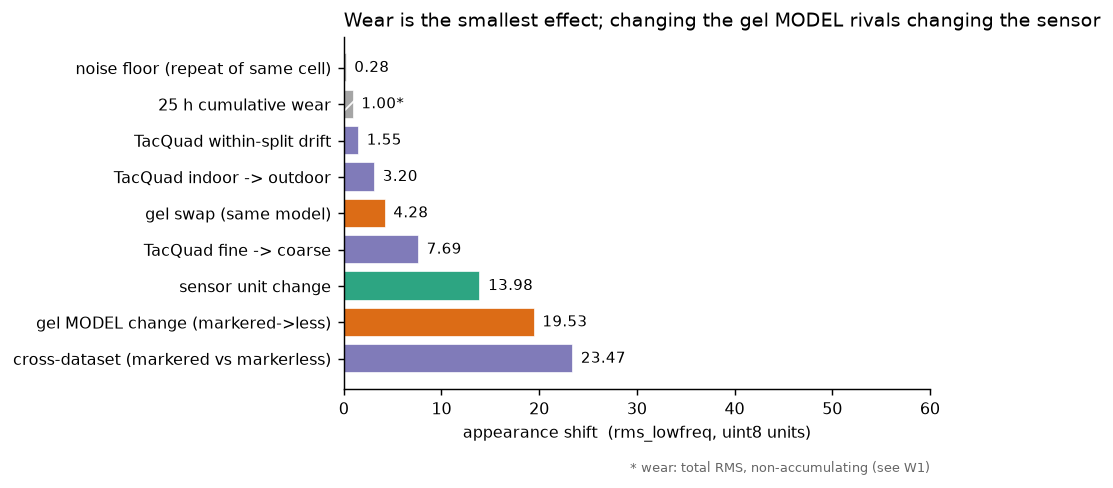 Every source of change on one comparable scale. Wear sits at the floor; the gel-model change exceeds the unit change. gel_axis.json, tacquad_domain.json, cross_dataset_gap.json
Findings
1 · Wear over 25 hours is undetectable strong
The 15.14 RMS shift over
24.9 h lands entirely on one 88-hour break
in acquisition; afterwards the signal stays within the floor
(1.07). A second 64-hour break moved it ~1 RMS, so
the step tracks the remount, not elapsed time. Consistent with GelSlim 2018.
detail →
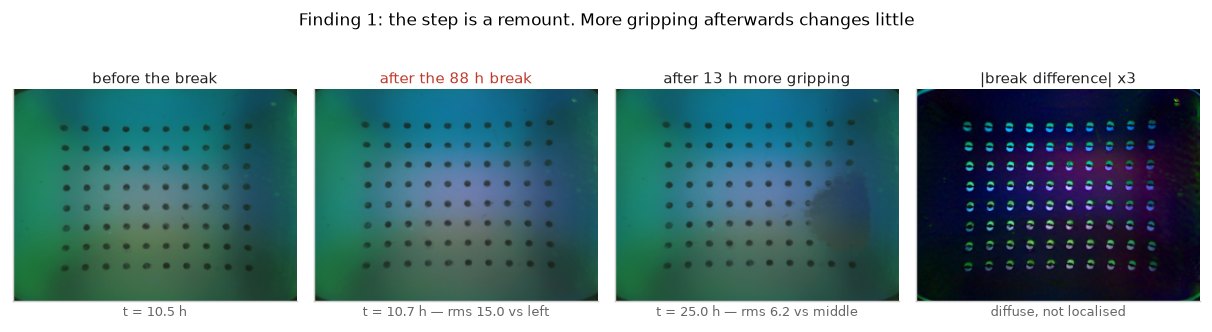 What changed, in the frames themselves: a global relight across the break, then almost nothing across 13 more hours of gripping. panda_durability_test_data/ted_gel
2 · A sensor swap costs almost nothing if you recapture the
reference frame strong
Over an 18.51 RMS sensor+gel shift,
re-estimating the reference — a per-pixel median of target images, no force labels —
holds transfer at
0.90;
reusing the source reference collapses it to
0.40.
detail →
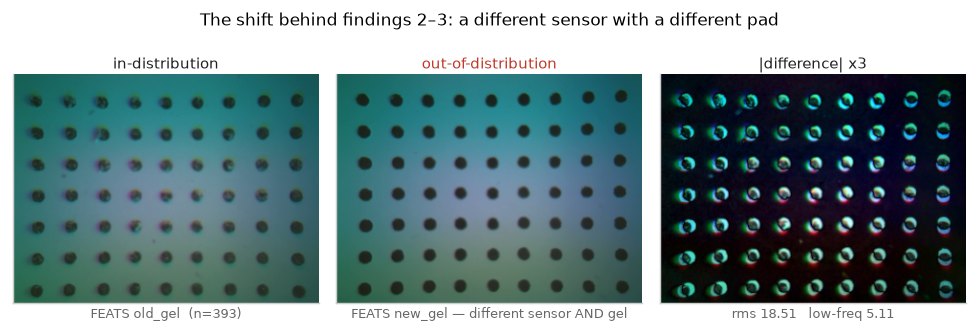 The out-of-distribution condition behind findings 2 and 3: a different sensor carrying a different pad, with force labels on both sides. FEATS test_diff_sensor_old_gel / _new_gel
3 · Generic frozen encoders all transfer; raw pixels do not
moderate
At a common feature width, four ImageNet/DINOv2 encoders land at 0.92–0.96
(2–5 % drops, none collapsing); the raw-pixel control drops
17 %. Size
shows no effect. detail →
4 · Bigger appearance shift, worse transfer — but the design is thin
weak
Undirected Spearman
-0.71
(p=0.111) over
6
independent shifts from
4
populations; a Mantel permutation over the population labels gives
p=0.083. The
direction is real; the significance is marginal.
detail →
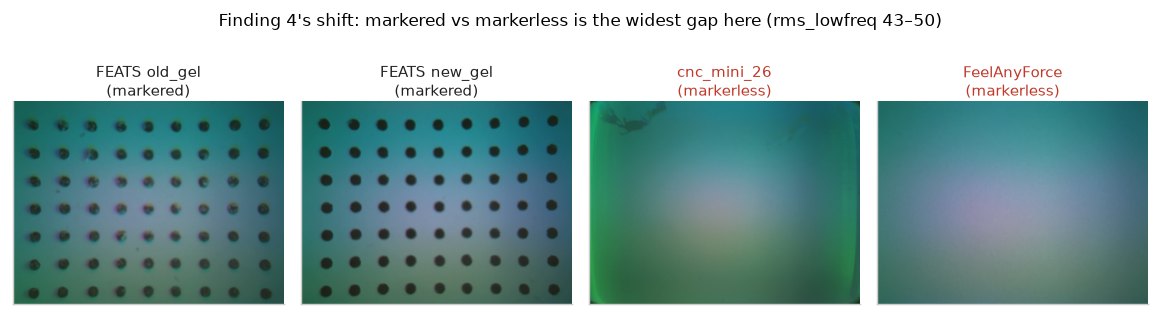 The four force-labelled populations. Two carry a printed dot lattice and two do not. That boundary costs 11.9-23.5 rms_lowfreq and collapses transfer, but the widest gap of all, 24.3, is between the TWO MARKERLESS sets. FEATS, cnc_mini_26, FeelAnyForce
What this does not support
Not a discovery — SITR, FeelAnyForce and FEATS already report cross-sensor
degradation. The contribution is quantification on a balanced crossed design.
Four earlier conclusions from this study were retracted after review:
see method.
Terms used on this site
| out-of-distribution (OOD) | Input that differs from what the estimator was fitted on — here: a different sensor, a different pad, or a different dataset. |
| reference frame | An image of the gel with nothing pressing it. Reconstruction works on the difference between a frame and this reference, so the reference carries the sensor's own illumination. |
| markered / markerless gel | GelSight pads either carry a printed lattice of black dots (used to read shear) or do not. It changes the image far more than swapping one pad for another of the same kind. |
| rms / rms_lowfreq | Root-mean-square pixel difference between two mean images, in 0–255 units. rms_lowfreq keeps only the smooth part — the only version that survives comparing images captured at different resolutions. |
| noise floor | What the statistic reads when nothing has changed: two averages of the same sensor, same pad. Any effect smaller than this is not measurable. |
| Spearman rho | Rank correlation, −1…1. It asks whether predictions ORDER the true forces correctly, ignoring scale — so it survives datasets with different force units. |
| in-domain vs transfer | In-domain: fit and score on the same population. Transfer: fit on one, score on another. The gap between them is the cost of the shift. |
| permutation null | The score the same procedure produces on shuffled data. Without it, a positive correlation can look meaningful when the procedure would produce one anyway. |
| Mantel permutation | A significance test for distance-vs-distance comparisons, where observations share populations and so are not independent. It relabels the populations instead of the observations. |
| LUT vs calibration-free | Two ways to turn an image into surface depth. The LUT (lookup table) is calibrated per sensor from known presses; the calibration-free solve is not, which is why the two degrade differently when the sensor changes. |
| degenerate transfer | The fitted map sends every target sample to one value, so rank correlation is undefined — total failure, not a missing measurement. |